Hardware & software
The imaging set-up
Today’s observatory rides on an Astro-Physics Mach 2 with an AP Starfire 110 GTX and a family of shorter scopes. The TMB 175 / Apogee write-up below is history from 2009–2015.
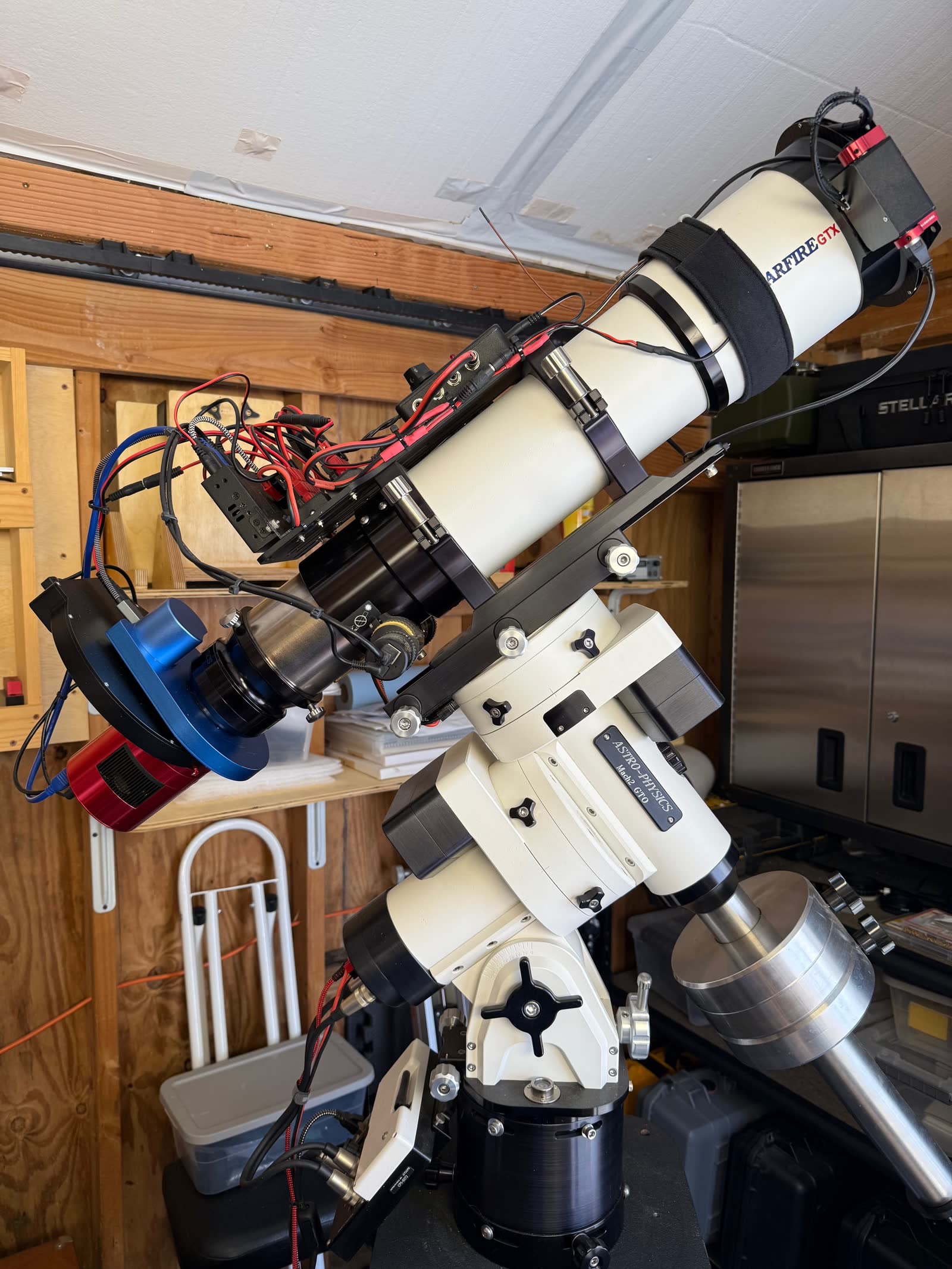
The mount is an Astro-Physics Mach 2. The main imaging scope on it right now is the AP Starfire 110 GTX. Also in the rotation: an AP Stowaway 92 mm, Stellarvue SVX130T and SVX80T, and a Takahashi FOA-60Q.
Cameras are a ZWO ASI2600MM and ASI2600MC. Software for the current rig is N.I.N.A., APCC Pro, and ASTAP.
Most of the deep-sky gallery was shot with earlier gear. The pictures and notes further down this page are that earlier chapter, not the current set-up.
Software (current)
What I use with the Mach 2 and ASI2600 cameras today:
| Application | Maker |
|---|---|
| N.I.N.A. | N.I.N.A. project |
| APCC Pro | Astro-Physics |
| ASTAP | han.k |
Archive
2009 configuration
The TMB 175 and Apogee U16M came off in 2015. This is the original write-up from when that was the imaging set-up, kept as history.


This was my imaging set-up then: a TMB 175mm f/8 APO refractor with an Apogee U16M camera and an AI-FW50-7S filter wheel. I bought the refractor off Astromart in February 2009, and I was the third owner. The tube was not the standard TMB/APM model. Markus Ludas had it built for an Aries fluorite lens that was never finished, then installed a 97.4 Strehl TMB lens in September 2004. The image train used an APM field flattener that did an effective job of producing pinpoint stars out to the corners of the Kodak 16803 chip.
The FRC-300 I had been using was an excellent scope, but I realized I was a “refractor guy” at heart. At 1400 mm focal length with the large U16M chip, that set-up gave a wonderful field of view. The guide scope on top was a Takahashi FS-78. Earlier guidescopes had been a Borg Mini45ED and a Takahashi FS-60; the FS-78’s extra focal length was the better fit then.
Guiding was handled by a Starfish from Fishcamp Engineering, one of the early production units from 2007. Focus for the imaging camera used a Starlight Instruments Feathertouch 3.5″ with a Robofocus. Custom adapters came from Ashley Stevens at PreciseParts. Dew control was a DewBuster with Dew-Not heater strips.
Earlier configurations
Most of the gallery was shot with the AP130 and ST-8E before the TMB 175 arrived. These frames are from the original equipment folders.
-

Paramount ME in the observatory. -

Earlier Takahashi BRC-250 and FSQ-106 stack. -

Astro-Physics AP130, behind most of the gallery images. -

SBIG ST-8E, used for the deep-sky gallery frames.
Software from that era
What was listed with the 2009 TMB / Apogee set-up. Not what runs the Mach 2 today.
| Application | Maker |
|---|---|
| MaxImDL/CCD v5 | Diffraction Limited |
| FocusMax | Brady & Weber |
| CCDStack | CCDWare |
| CCD Inspector | CCDWare |
| SkyTools 3 | CapellaSoft |
| ACP4 | DC-3 Dreams |
| PinPoint | DC-3 Dreams |
| CCDAutoPilot4 Professional | CCDWare |
| TheSky 6 | — |
| Photoshop CS3 | Adobe |